George H. W. Bush - 'We have before us'
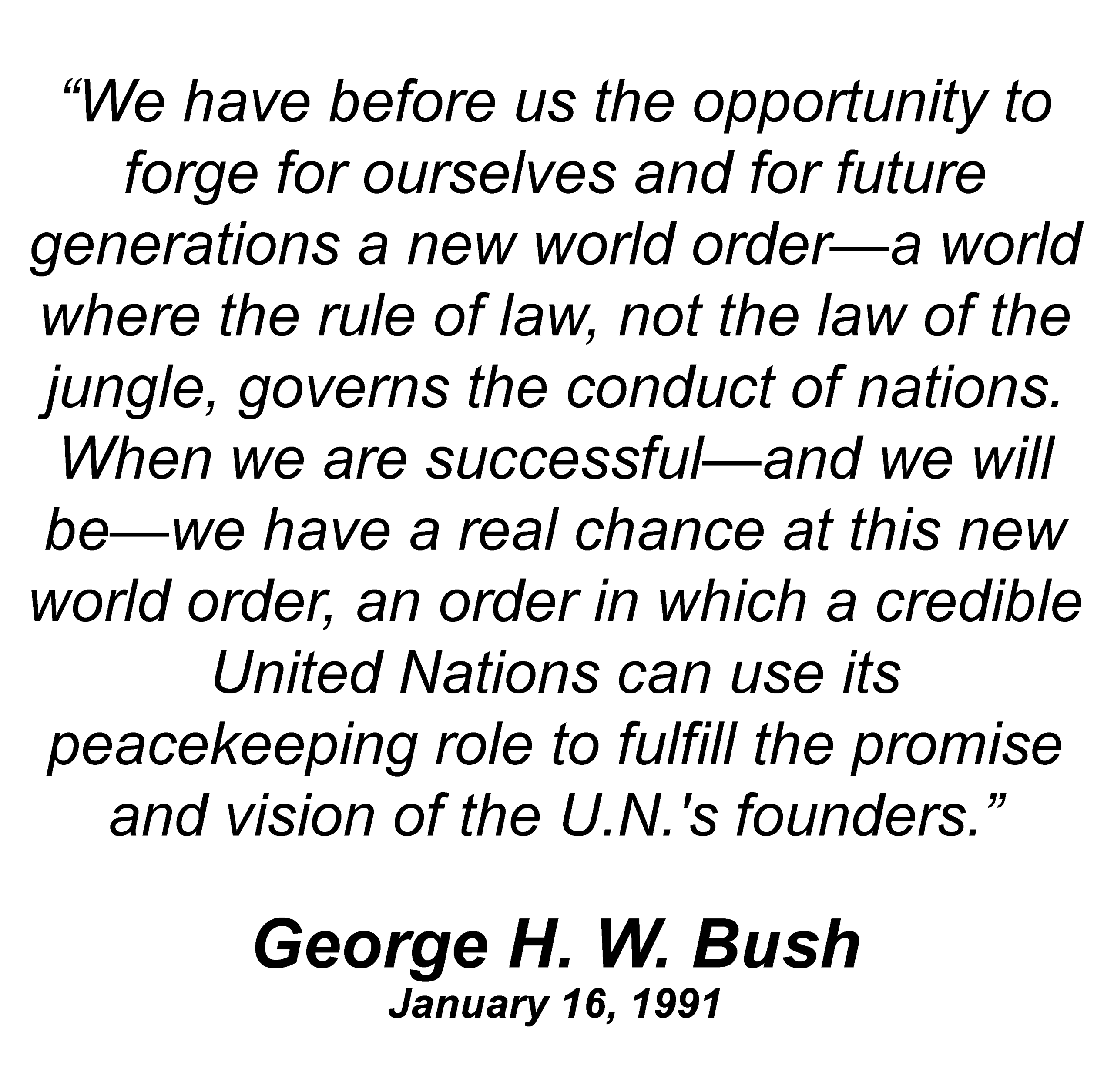
The phrase “New World Order,” used by President George H. W. Bush on January 16, 1991, referred to a vision of post–Cold War international cooperation. The speech, delivered during the Gulf War period, introduced language that has since been interpreted in diplomatic, political, and cultural contexts.
Context, Interpretation, and Later Usage
Historical Context
This statement was delivered by U.S. President George H. W. Bush on January 16, 1991, during an Address to the Nation on the Invasion of Iraq, as U.S.-led coalition forces began military operations following Iraq’s invasion of Kuwait. The speech occurred near the end of the Cold War, at a time when the Soviet Union was in decline and new international power structures were emerging.
In this context, Bush described a vision of increased international cooperation, emphasizing collective security, adherence to international law, and a strengthened role for the United Nations in peacekeeping. His remarks reflected prevailing diplomatic discussions of the period regarding how global institutions might function in a post–Cold War environment.
Meaning of “New World Order” in the Speech
In Bush’s usage, the phrase “new world order” referred to a proposed international system in which nations would work collaboratively to resolve conflicts through established legal and diplomatic mechanisms. The concept emphasized multilateral cooperation rather than unilateral action, with the United Nations positioned as a central forum for conflict resolution and peacekeeping.
This framing aligned with longstanding goals of international governance that emerged after World War II, particularly those embedded in the United Nations Charter, which sought to prevent large-scale conflict through collective action and diplomacy.
Later Interpretations and Cultural Afterlife
In the years following the speech, the phrase “new world order” took on meanings beyond its original diplomatic context. Some commentators and belief communities interpreted the term as signaling a hidden or centralized global power structure. These interpretations were not part of the speech’s stated intent but became influential within certain political, religious, and cultural subcultures.
As a result, the phrase has appeared frequently in conspiracy literature, popular media, music, and documentaries, where it is often used symbolically to represent fears of global control, loss of national sovereignty, or elite governance. Scholars studying conspiracy culture have described Bush’s speech as a commonly cited example of how neutral political language can acquire alternative meanings over time.
Conspiracy Beliefs and Religious Interpretations (Overview)
Within some conspiracy-oriented and apocalyptic belief systems, the “new world order” is portrayed as a future global authority that would supersede national governments. In certain religious interpretations, particularly within some strands of Christian eschatology, this concept has been linked to end-times narratives described in the Book of Revelation.
These interpretations vary widely and are not supported by historical evidence regarding the intent of Bush’s speech or the founding documents of the United Nations. Academic and journalistic analyses generally treat such beliefs as examples of how political language can be reinterpreted within broader ideological or theological frameworks.
Summary
George H. W. Bush’s January 16, 1991 reference to a “new world order” was made within a specific historical moment marked by the end of the Cold War and active military conflict in the Persian Gulf. While the phrase originally referred to diplomatic and legal frameworks for maintaining global stability, it has since developed a complex cultural afterlife, appearing in conspiracy theories, religious interpretations, and popular media. This page documents both the original context and subsequent reinterpretations without endorsing any particular viewpoint.

References and Source Material
The following sources document the historical context of the quote, its original diplomatic meaning, and the range of interpretations and cultural uses that developed afterward. Inclusion of a source reflects its relevance to public discourse and analysis and does not imply endorsement of any particular viewpoint.
Primary Source (Historical Record)
- Bush, George H. W. Address to the Nation on the Invasion of Iraq, January 16, 1991.
— Primary historical source for the quoted passage referencing a “new world order,” delivered at the outset of U.S.-led coalition military operations during the Gulf War.
Mainstream Political History and Journalism
- Meacham, Jon. Destiny and Power: The American Odyssey of George Herbert Walker Bush (2015).
— Biographical analysis of Bush’s presidency, including the Gulf War and post–Cold War diplomacy. - Woodward, Bob. The Commanders (1991).
— Contemporary journalistic account of U.S. leadership decisions during the Gulf War period.
Academic and Credible Analyses of Conspiracy Culture
Ronson, Jon. The Secret Rulers of the World (2001).
— Explores modern conspiracy belief systems and how political language is reinterpreted within them.PBS Frontline. The United States of Conspiracy / The Lost American Dream.
— Documentary examinations of conspiracy thinking in modern American political culture, including references to the phrase “new world order.”
Conspiratorial and Prophetic Interpretations
(Documented for cultural and analytical context)
Cooper, William. Behold a Pale Horse (1991).
— Frames Bush’s speech as apocalyptic or prophetic.Epperson, A. Ralph. The New World Order (1989; updated editions).
— Interprets Bush’s language through a conspiratorial lens.Allen, Gary. None Dare Call It Conspiracy (1971; later reissued editions).
— Earlier conspiratorial framework later applied to Bush-era rhetoric.Hays, Jeff Michael Thomas. The Rise of the New World Order: The Culling of Man (2013).
— Apocalyptic interpretation linking global governance to depopulation narratives.Dice, Mark. Big Brother: The Orwellian Nightmare Come True (2009).
— Surveillance-state framing tied to “new world order” discourse.Hoagland, Richard. Dark Mission: The Secret History of NASA (2007).
— Expands conspiratorial interpretations into space and government secrecy themes.
Film, Television, and Documentary Media
(Cultural representations and reinterpretations)
Scripted and Popular Media
The X-Files (1993–2018) — Fictional narratives echoing “new world order” themes.
The Simpsons — Satirical references to global governance and elite control.
They Live (1988) — Retrospectively associated with elite-control narratives after 1990.
Documentary and Pseudo-Documentary
Zeitgeist (2007; sequels) — Uses Bush’s quote to frame global control narratives.
Conspiracy Theory with Jesse Ventura (2009–2012, TruTV).
Endgame: Blueprint for Global Enslavement (2007, Alex Jones).
America: Freedom to Fascism (2006, Aaron Russo).
History / Discovery Channel specials on the “New World Order.”
9/11 conspiracy documentaries (Loose Change, Fabled Enemies).
Music and Audio Culture
(Sampling and symbolic usage)
Ministry — “New World Order” (1992).
Immortal Technique — “Cause of Death.”
Megadeth — “Symphony of Destruction.”
Dead Prez — “Propaganda.”
Rage Against the Machine — “Sleep Now in the Fire.”
Public Enemy — Fear of a Black Planet era.
Jedi Mind Tricks — Multiple tracks referencing Bush-era rhetoric.
Metallica — “Don’t Tread on Me” (1991).
Underground mixtapes (1990s–2000s) sampling Bush’s speech.
Images, Visuals, and Iconography
Historical Documentation
Official photographs and video of President Bush delivering the January 16, 1991 address
Newspaper headlines from September 1990 referencing the “new world order.”
Conspiratorial and Protest Imagery
(Documented examples of later reinterpretation)
Protest signage from militia and anti-globalization movements.
Online conspiracy thumbnails and memes incorporating Bush’s image.
QAnon and apocalyptic visual reinterpretations.
Infowars / PrisonPlanet graphic composites.
Related Products
-
T-Shirts
George H. W. Bush Quote 01-16-1991 Heavyweight T-Shirt – Black
$23.00 – $32.00Price range: $23.00 through $32.00 Select options This product has multiple variants. The options may be chosen on the product page -
T-Shirts
George H. W. Bush Quote 01-16-1991 Heavyweight T-Shirt – White
$24.50 – $34.50Price range: $24.50 through $34.50 Select options This product has multiple variants. The options may be chosen on the product page -
Sweatshirts
George H. W. Bush Quote 01-16-1991 Unisex Hoodie – Black
$43.50 – $50.00Price range: $43.50 through $50.00 Select options This product has multiple variants. The options may be chosen on the product page -
Sweatshirts
George H. W. Bush Quote 01-16-1991 Unisex Hoodie – White
$43.50 – $50.00Price range: $43.50 through $50.00 Select options This product has multiple variants. The options may be chosen on the product page